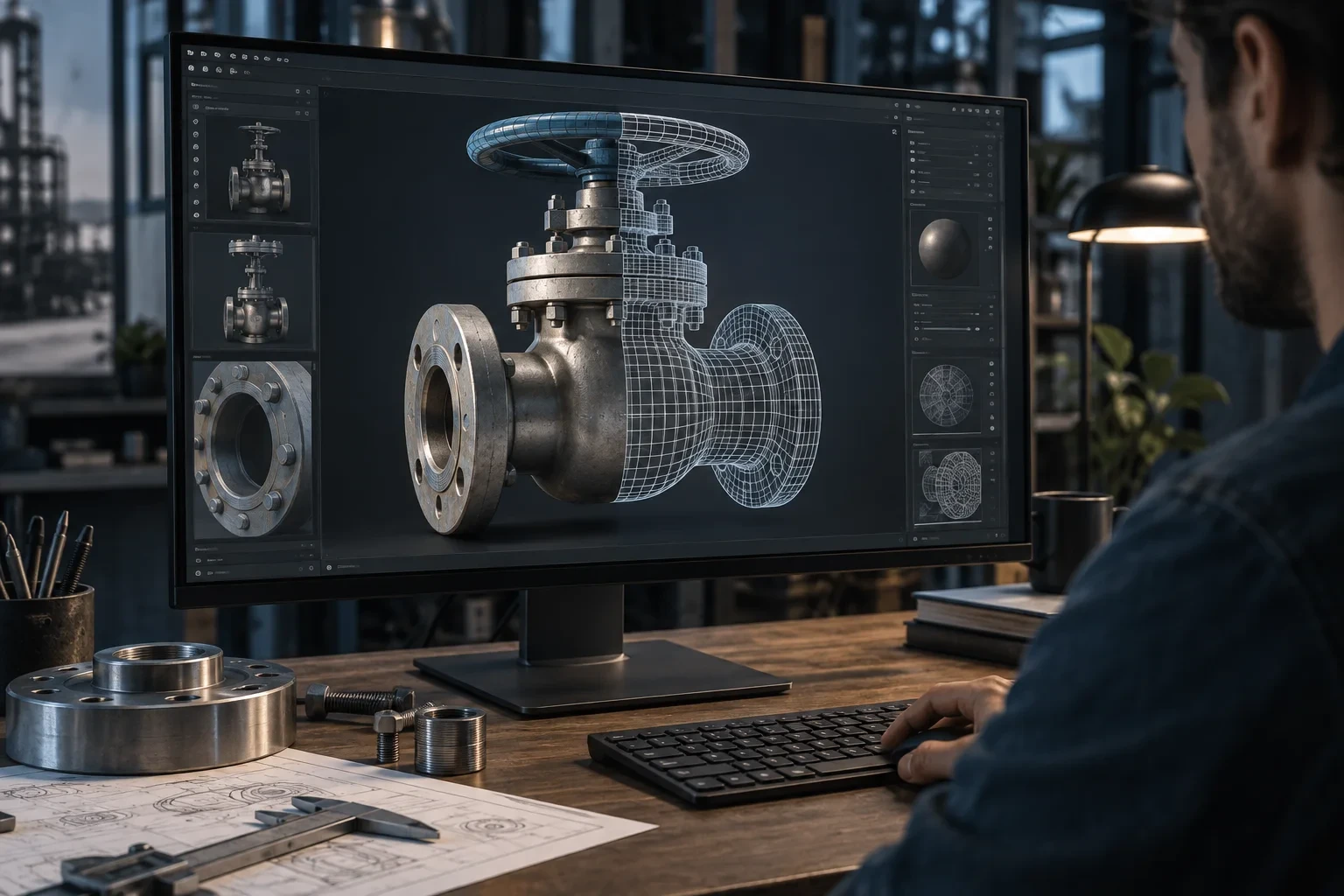
An asset can look convincing in a render and still be wrong for an interactive application. We create 3D models with the destination in mind: how close the audience gets, how the object moves and what the target hardware can render.
01 / Our approach +
Agree the specification before building the detail
Our asset work connects visual craft with practical delivery requirements. Reference review, topology, materials and optimisation are planned together so the handover supports the next stage of production.
A product model, a background prop and an animated character need different structures. We establish scale, material references, geometry budgets and export requirements before production. Representative assets provide a useful quality benchmark for a larger batch.
02 / Production scope
What we can build with you.
01
Modelling and surface work
+
Create geometry, UVs and materials from agreed references, with review stages for shape and visual treatment.
02
Real-time optimisation
+
Prepare suitable geometry, texture sizes and levels of detail where required by the target experience.
03
Technical handover
+
Deliver agreed file formats, naming conventions and validation notes for integration into your pipeline.
Prepare objects for interactive viewing, AR placement or campaign content.
02
Environment and prop libraries
+
Build consistent asset sets for virtual spaces and gameplay environments.
03
Character production support
+
Scope character modelling and associated production stages alongside rigging and performance requirements.
04 / Planning your project +
Specify the handover your team actually needs.
For 3D modelling services, the delivery checklist matters as much as the visual reference. Establish units, orientation, naming conventions, material workflow and the software versions used downstream. If assets need multiple levels of detail, define where those levels will be used rather than treating them as a generic extra. A sample import into the destination engine can expose issues that a turntable render will not show. For batches, agree how feedback is consolidated and which approved sample sets the quality bar, so revisions remain consistent across the whole asset library.
A useful brief makes the next step clearer.
You do not need a finished specification to start a conversation. Share the intended audience, the outcome you need and any existing material. Include a target date or platform constraint if you have one. We can use those details to discuss the right starting point and the questions a production scope needs to answer.
Start with a conversation.
Send a representative asset, reference material and the engine or viewer it needs to work in.
Yes, subject to the quality and completeness of the source material. Missing views or dimensions may require additional references or explicit modelling assumptions.
Do you include rigging and animation?+
They can be scoped, but are not automatically part of every modelling commission. Tell us how the asset needs to move and which rig or engine it must support.
How do you handle a large asset catalogue?+
Start with representative samples and an agreed specification. This helps establish review criteria before scaling production across the catalogue.
Who owns the source files?+
Source-file delivery, licences and ownership should be agreed in the project contract, including restrictions attached to any third-party material.
06 / 3D modelling and asset creation
Tell us what you want to build.
Send a representative asset, reference material and the engine or viewer it needs to work in.