

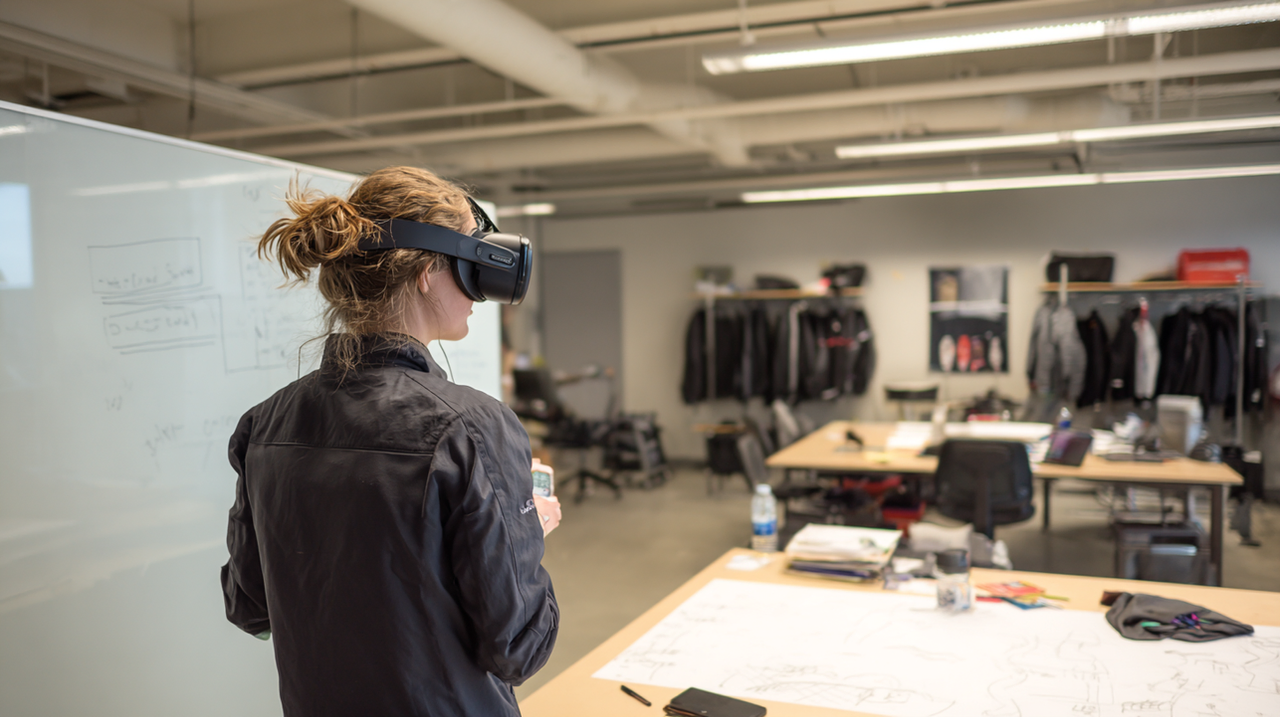
Can teams prepare for dangerous work before anyone enters the real environment?
XR safety training simulations help companies turn complex, hazardous, or expensive workplace scenarios into repeatable practice. Instead of relying only on classroom instruction, static manuals, or one-time demonstrations, teams can enter a virtual, augmented, or mixed reality environment and rehearse the exact decisions, movements, and communication patterns required on the job.
For Mimic XR, this sits at the center of immersive enterprise learning: photorealistic spaces, smart avatars, real workflow logic, measurable performance, and safe repetition. It connects naturally to XR training simulations, mixed reality solutions, and the wider Mimic XR services built for training, visualization, and interactive worlds.
Table of Contents
What are XR safety training simulations?

XR safety training simulations are immersive practice environments built with virtual reality, augmented reality, mixed reality, real-time 3D, and interaction design. A learner can inspect equipment, follow procedures, respond to incidents, or collaborate with teammates while the system tracks timing, accuracy, choices, and completion quality.
The goal is not to replace real-world competence. The goal is to prepare people before real-world exposure. In a safety-critical environment, the first time someone makes a decision should not be during a live emergency, a shutdown, a high-voltage inspection, or a customer-facing failure. XR lets organizations compress practice cycles without increasing operational risk.
A well-built simulation can include spatial instructions, realistic objects, timed interruptions, branching choices, voice guidance, and post-session reporting. When combined with virtual world development and high-quality digital assets, safety practice starts to feel less like a quiz and more like controlled experience.
Why safety training is moving into XR

Traditional safety training often struggles with three limits: it is difficult to recreate rare events, expensive to interrupt production for practice, and hard to measure whether people can actually perform under pressure. Slides may explain a lockout sequence, but they cannot reproduce urgency, spatial judgment, or the consequences of skipping a step.
XR changes that by making the scenario repeatable. A manufacturing team can rehearse machine isolation. A healthcare team can practice a high-stress response. Retail or customer-service teams can prepare for tense interactions. Field teams can use AR product visualization and guidance techniques to understand equipment in context instead of learning from detached diagrams.
The strongest business case appears when training is high-risk, hard to schedule, or inconsistent across locations. That is why XR is increasingly used for corporate learning, manufacturing, healthcare, design, education, sports, and customer service scenarios. Mimic XR's industries page shows how those use cases expand across sectors.
Where XR safety simulations create the most value

XR safety simulations are especially effective when a team needs procedural confidence, spatial awareness, and decision-making under realistic conditions. They are useful for onboarding, refresher training, certification preparation, remote assistance, emergency response, equipment inspection, customer service escalation, and operational readiness.
Industrial safety: machine startup, shutdown, inspection, hazard recognition, and emergency response.
Healthcare and medical training: repeatable procedural practice without putting patients at risk.
Corporate learning: scalable simulations for teams distributed across offices, countries, and languages.
Design and manufacturing: safe interaction with digital twins before physical prototypes or production changes.
For a deeper grounding in the broader concept, Mimic XR's existing guide to virtual training with XR and real-time simulation explains why immersion, presence, and interactivity matter for skill-building.
How Mimic XR designs realistic training environments

Effective safety training depends on realism, but realism is not only visual. It includes accurate scale, believable object behavior, useful feedback, clear learning objectives, and the right level of pressure. Too little realism makes training feel abstract. Too much irrelevant detail can distract from the safety behavior that matters.
Mimic XR's production background is useful here. The studio's work in photoreal digital humans, performance capture, scanning, character modeling, facial rigging, animation, AI integration, and real-time 3D assets gives simulations a level of presence that standard e-learning cannot offer. The about Mimic XR page describes that foundation in Mimic Productions' award-winning 3D and digital-character work.
A safety simulation may start with 3D scanning and photogrammetry to capture a real object or workspace. It may use motion capture and performance to make people, gestures, and responses feel human. Then interaction design turns the environment into a guided training experience with scoring, branching, and feedback.
The role of smart avatars and AI instructors

One of the most powerful parts of XR safety training is the ability to put a guide inside the experience. A smart avatar can explain a procedure, answer basic questions, model correct behavior, interrupt when a learner misses a critical step, or play the role of a customer, patient, supervisor, teammate, or bystander.
This matters because many safety failures are not caused by lack of information alone. They are caused by hesitation, miscommunication, attention overload, or poor sequencing. Smart avatars and NPCs can bring social and cognitive pressure into the simulation without putting real people in danger.
For enterprise learning, AI instructors can also help scale consistent coaching. A learner in Berlin, Dubai, London, or New York can receive the same procedural baseline while still practicing in a scenario that responds to individual behavior. Mimic XR's post on AI XR training simulations and smart avatars explores that direction in more detail.
What to measure before rollout

Before an XR safety program rolls out, define what success means. The best simulations measure more than completion. They track decisions, timing, sequence accuracy, communication, hazard recognition, repeat attempts, confidence growth, and transfer readiness. That data helps learning leaders improve the module and helps operations teams understand whether training is changing behavior.
Useful metrics include error reduction across attempts, time to complete critical tasks, number of hints requested, steps skipped, incident-response choices, voice or teamwork prompts, and manager review notes. In some cases, organizations also compare XR training outcomes with classroom or video-based learning to understand where immersion is producing measurable lift.
A practical rollout often begins with one high-value scenario. Choose a workflow that is risky, repeated, expensive to stage, or difficult to standardize. Build the first module, test it with subject-matter experts, refine the interaction model, then expand into related modules. This keeps the program focused and makes ROI easier to prove.
FAQ
What is the primary keyword for this topic?
The primary keyword is xr safety training simulations. Related keywords include virtual reality safety training, enterprise XR training, immersive safety training, mixed reality training, digital twin training, AI avatars for training, and VR workplace safety.
Is XR safety training only for industrial teams?
No. Industrial training is a strong use case, but XR safety simulations also support healthcare, education, customer service, retail, sports, design, and corporate learning teams that need realistic practice without unnecessary risk.
How is XR training different from normal VR training?
VR training is one part of XR. XR can include VR, AR, MR, spatial computing, digital twins, and smart avatars. That means training can happen in a fully virtual space, as an overlay on the real world, or as a blended mixed reality workflow.
Can XR simulations reduce workplace incidents?
They can support incident reduction when they are tied to real procedures, proper coaching, management adoption, and repeated practice. XR is most effective when it reinforces behavior that the organization also measures and supports on the job.
What content should be included in a safety simulation?
Start with the real workflow: environment, equipment, correct sequence, common errors, decision points, escalation paths, and success criteria. Then add interaction, feedback, scoring, and realistic pressure only where it improves learning.
Do companies need 3D scanning for every XR training project?
Not always. 3D scanning and photogrammetry are useful when exact objects, spaces, or equipment matter. For conceptual or behavioral training, custom 3D models and well-designed interactions may be enough.
How do AI avatars improve safety training?
AI avatars can guide learners, simulate realistic human responses, create dialogue-based branching, and provide coaching. They are especially useful when communication, confidence, and judgment are part of the safety challenge.
What is the best first XR safety training module to build?
Choose a scenario that is important, repeatable, and difficult to practice safely in real life. Strong first modules often involve emergency response, equipment inspection, hazard recognition, onboarding, or a procedure where mistakes are costly.
Conclusion
XR safety training simulations give organizations a better way to prepare people for work that is complex, risky, or hard to rehearse. When the simulation combines realistic environments, smart avatars, accurate workflows, and measurable outcomes, training becomes active practice rather than passive content consumption.
If your team needs immersive training that reflects real procedures, real environments, and real performance goals, explore Mimic XR's training simulation services or contact Mimic XR to shape a safety training experience around your workforce, equipment, and rollout goals.