
VR marketing is most useful when being inside an experience helps someone understand a product, place or story. It should solve a communication problem that a conventional format cannot solve as well within the campaign’s constraints. This guide covers practical use cases and measurement design; it does not promise an uplift or present hypothetical results as client evidence.
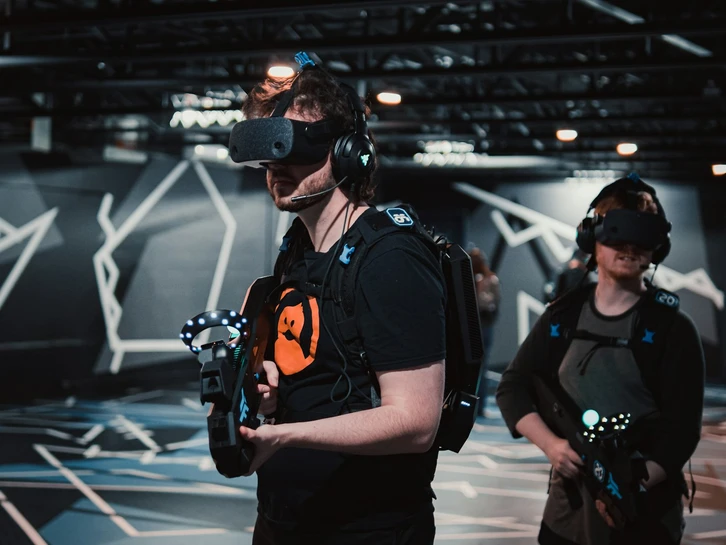
Cover photograph: Unsplash. Illustrative stock photograph; it does not depict a tested device comparison or a Mimic XR client project.
In this guide
Product demonstrations that explain a spatial benefit
Use VR when a product is difficult to transport, too large for the venue or best understood through a spatial sequence. Let visitors perform one meaningful action: inspect an assembly, compare a layout or experience a change in scale.
Keep the message focused. A long sequence of features can make the interaction harder to explain and reduce visitor throughput. If a phone-based placement experience answers the same question with less effort, consider AR product visualisation instead.
Brand stories and experiential installations
A virtual environment can help visitors experience a setting or viewpoint that cannot be recreated at the event. Define what the visitor should remember and how the interaction supports that message. Provide an alternative way to access the key story for visitors who do not use a headset.
For external inspiration, Groove Jones’ published work includes immersive activations. Its platform overview discusses location-based delivery. These are third-party examples, not Mimic XR projects or independently verified ROI results.
Connect the experience to the customer journey
Decide what happens after the headset comes off. It might be a product discussion, a saved configuration, a requested demonstration or a relevant follow-up chosen by the visitor. Make that action understandable and voluntary.
Do not treat participation as a qualified lead automatically. Define the qualification criteria with the sales team and keep event operations separate from marketing data collection. Avoid collecting personal information that is unnecessary for the agreed next step.
Plan the event operation
Calculate capacity using the whole session: introduction, fitting, experience, removal, cleaning and reset. Include charging, spare equipment, staffing and a recovery plan. Test the actual venue conditions and the most common interruptions.
Use events and brand activation planning or location-based immersive experiences to scope those requirements. The experience is only one part of a successful activation.
Measure outcomes without inventing attribution
Define the campaign objective and its baseline before launch. Record eligible visitors, completed sessions, task completion, requested follow-ups and the cost of delivery. Separate engagement measures from commercial outcomes. A long session might indicate interest or confusion; it is not automatically positive.
For ROI, compare attributable incremental value with total campaign cost using an agreed attribution method and observation period. Where attribution is uncertain, report cost per completed demonstration or qualified follow-up instead of manufacturing a revenue figure. Use the XR brief template and contact Mimic XR to define a testable activation.
Frequently asked questions
When is VR useful for marketing?
When spatial participation helps explain a product, place or story better than the available alternatives.
Does every activation need a headset?
No. Select the format around audience access, the message and the venue.
Is a participant automatically a lead?
No. Qualification and follow-up permission require separate criteria.
What limits visitor throughput?
The full session cycle, including onboarding, fitting, cleaning and reset.
Does longer dwell time prove success?
No. It can reflect interest, confusion or operating delays.
What should a small pilot measure?
Task completion, message understanding, operating reliability and the intended next step.
Can we claim ROI without attributable revenue?
Report the available outcome and cost measures clearly rather than inventing revenue attribution.
What should be in the campaign brief?
Audience, message, interaction, venue, staffing, devices, budget and an agreed evaluation method.