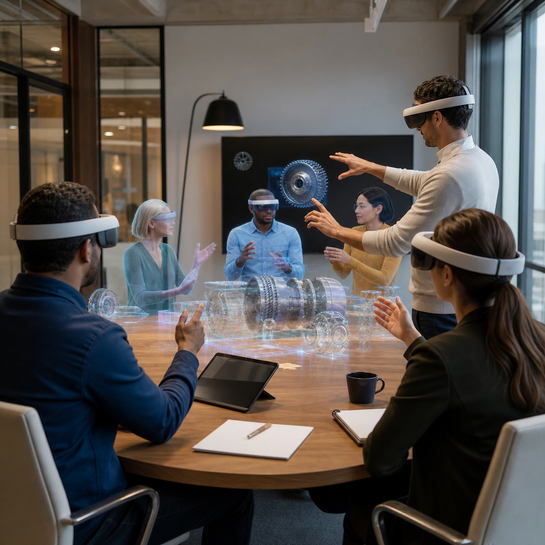
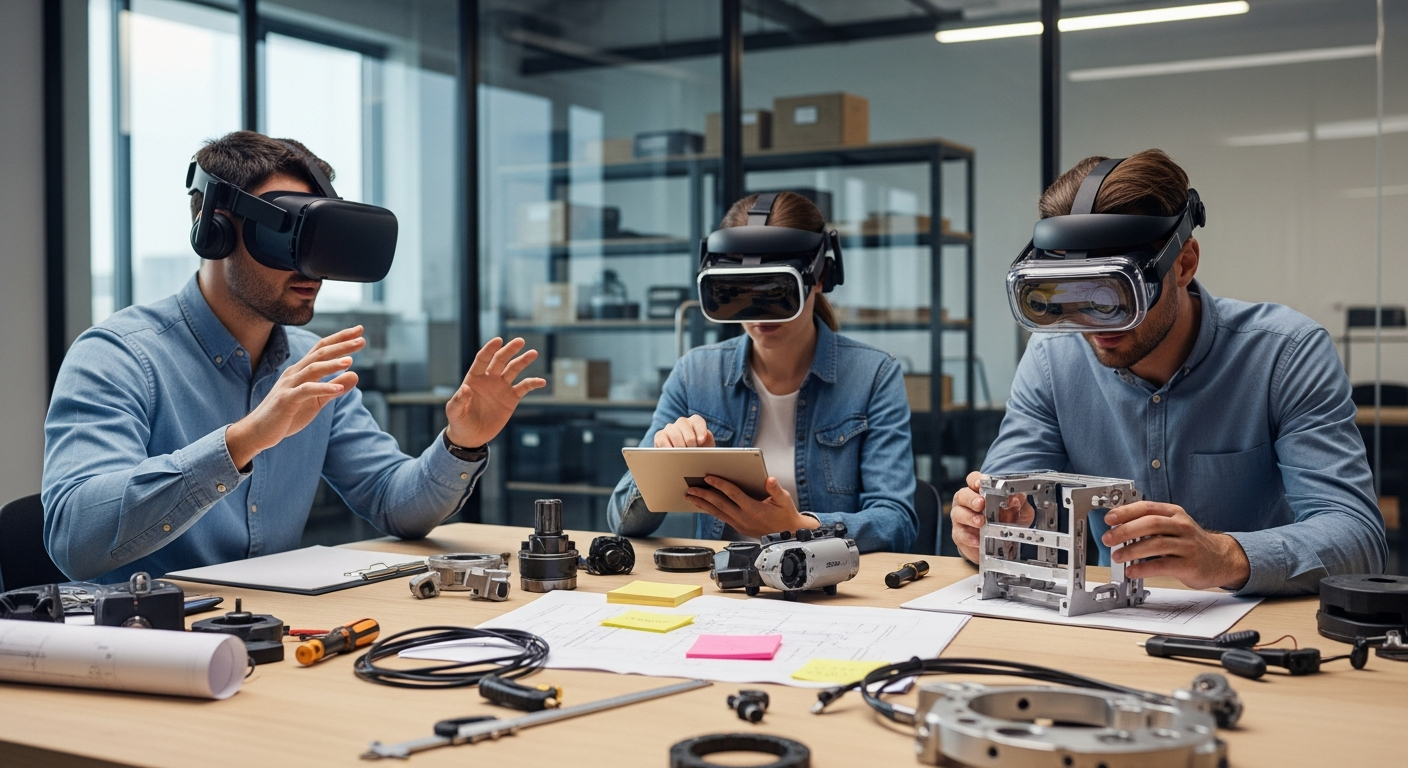
Mixed reality solutions are becoming practical tools for companies that need more than another screen. They help teams place digital information, 3D models, smart avatars, and guided workflows directly inside real environments, so people can learn, design, collaborate, and make decisions with spatial context.
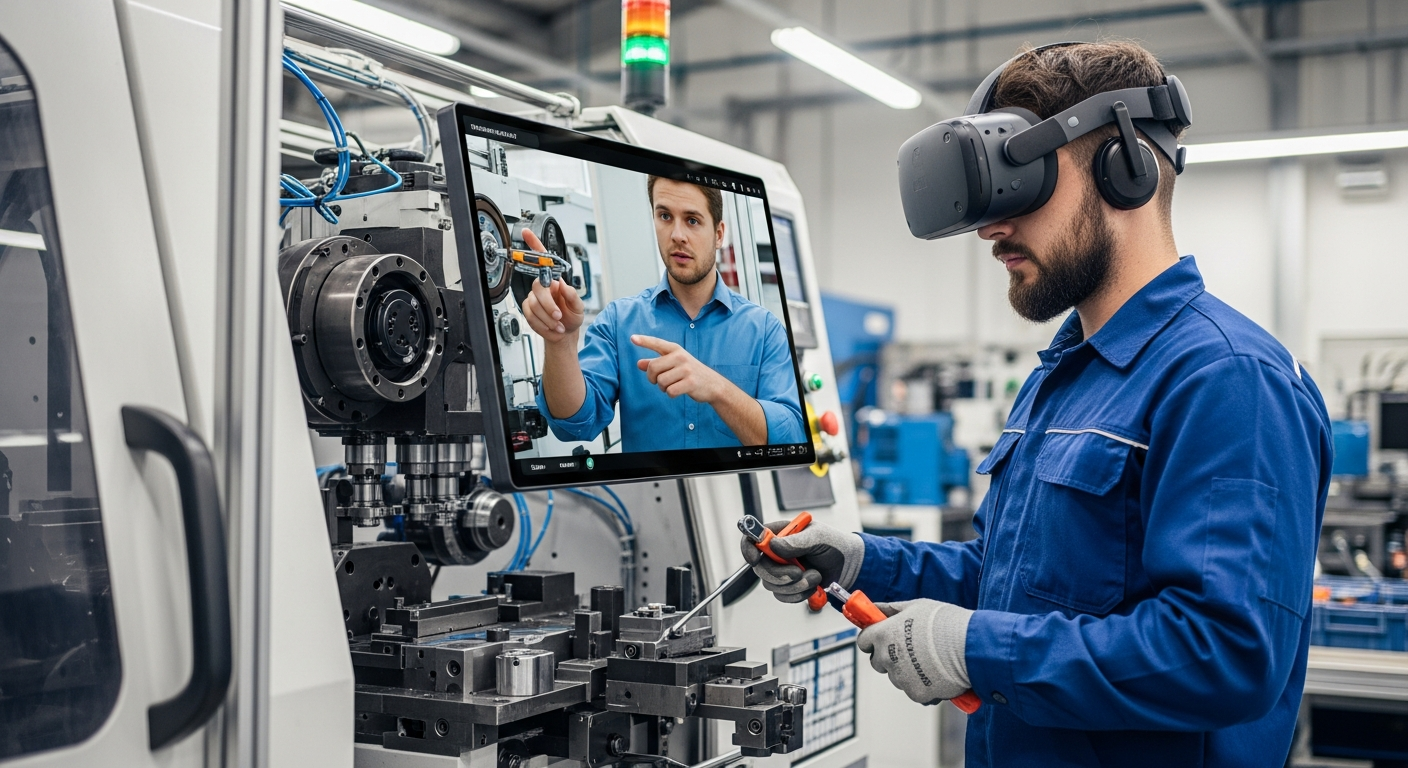
Unlike fully virtual environments, mixed reality keeps the physical world present. A technician can see equipment while receiving visual guidance. A product team can inspect a digital prototype at real scale. A trainer can place a realistic digital human inside a scenario without removing the learner from the room.
For Mimic XR, this sits naturally alongside virtual world development, AR product visualization, XR training simulations, and smart avatar work built around cinematic realism.
Table of Contents
What Mixed Reality Solutions Actually Do
Mixed reality blends real spaces with interactive digital content. It can recognize surfaces, track hands or controllers, understand where a person is standing, and keep virtual objects anchored in a physical environment. That makes it useful when context matters: an engine, a store layout, a medical room, a stage, a classroom, or a product prototype.
A strong MR experience usually combines spatial mapping, real-time 3D rendering, responsive interaction, and content designed for human attention. The foundation is similar to the wider XR ecosystem explained in how extended reality works, but mixed reality has a special advantage: it lets users act inside the real environment instead of switching away from it.
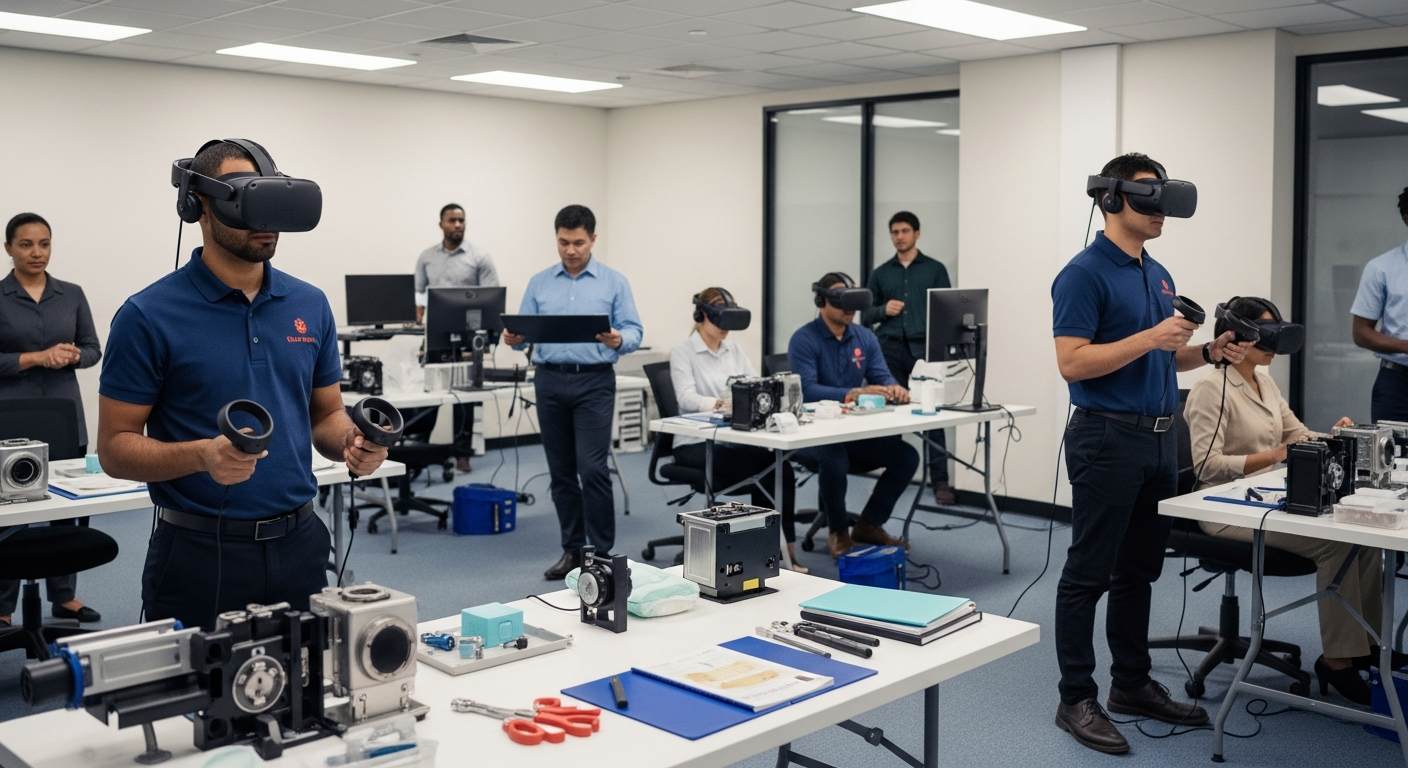
Training: digital instructions, hazards, and role-play scenarios appear in the room where skills are practiced.
Visualization: teams inspect products, machinery, environments, or spatial data at real scale.
Collaboration: remote and local users can review the same 3D content while talking, pointing, and annotating.
Customer experience: shoppers, visitors, patients, or guests can understand complex offers through spatial interaction.
Mixed Reality vs AR vs VR
MR is often discussed alongside AR and VR, but the best choice depends on the workflow. The detailed difference between VR, AR, and MR in enterprise adoption is worth understanding before a team invests in hardware or content.
AR: best for lightweight overlays on phones, tablets, or glasses when users need quick product previews or simple field guidance.
VR: best for full simulation when the real environment is unavailable, risky, expensive, or impossible to recreate physically.
MR: best when digital guidance must stay tied to real equipment, real rooms, real people, or real objects.
XR: the umbrella strategy that combines AR, VR, MR, real-time engines, 3D assets, avatars, and spatial interaction.
Benefits for Enterprise Teams
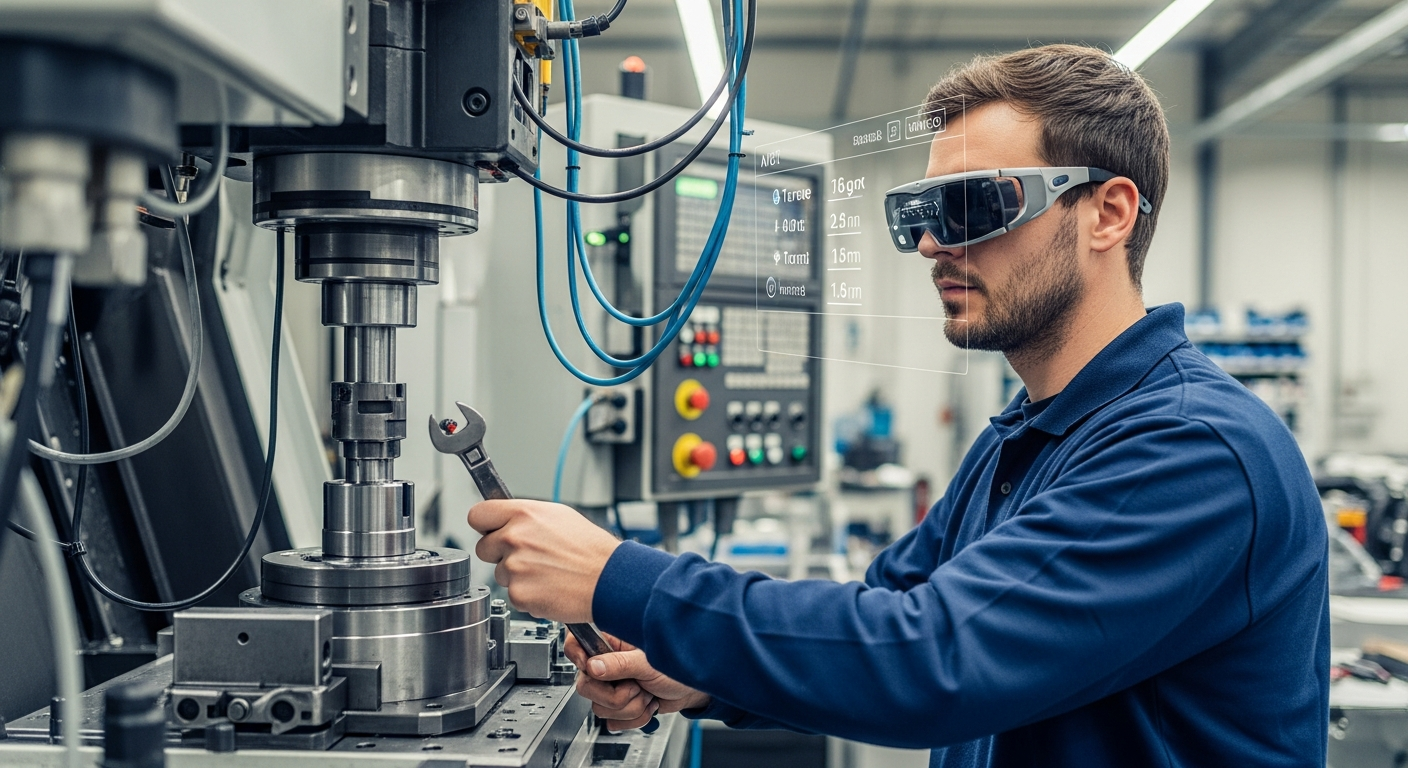
The business case for mixed reality solutions is strongest when a team needs to reduce ambiguity. Static manuals, flat dashboards, and video calls can explain a process, but MR can show where action should happen and how each step connects to the physical world.
Faster comprehension: people understand size, distance, sequence, and context more quickly when information is spatial.
Safer practice: employees can rehearse procedures with guided overlays before they face high-pressure conditions.
Better collaboration: teams can discuss the same object, asset, or digital twin instead of interpreting separate screens.
More memorable experiences: believable environments and smart avatars create presence, which supports engagement and retention.
These benefits are especially visible in virtual reality training programs for global teams and in MR systems that bring those simulation principles back into real-world workspaces.
Industry Use Cases
Mixed reality is not a single-use technology. It becomes valuable when the experience is designed around the environment, the user role, and the decision the person needs to make.
Manufacturing and design: overlay assembly guidance, inspect digital twins, and review equipment layouts before changes are made.
Healthcare and education: support anatomy learning, guided procedures, scenario training, and patient or student explanation.
Entertainment and live events: blend physical stages with virtual characters, spatial effects, and audience interaction.
Data and 3D Asset Requirements
The best mixed reality solutions are built on accurate inputs. A beautiful prototype will still fail if the 3D assets are too heavy, the spatial map is unreliable, or the training logic does not reflect the real procedure.
3D models and digital twins: optimized geometry, correct scale, clean materials, and useful levels of detail.
Environment data: room scans, surface detection needs, lighting conditions, and safe movement zones.
Workflow logic: task steps, branching decisions, success criteria, and feedback moments.
Human performance data: what should be measured, stored, anonymized, or avoided.
Character and avatar inputs: scanning, rigging, facial animation, voice behavior, and AI boundaries when digital humans are involved.
How to Implement Mixed Reality
Implementation works best as a phased production process, not a one-shot technology experiment. The goal is to prove value early, then expand the experience once the workflow, device, and content strategy are clear.
Define the target workflow: choose one training task, review process, product demo, or support journey where spatial context matters.
Choose the device path: decide whether the first version needs headsets, tablets, phones, or multi-device access.
Build the core spatial prototype: test tracking, scale, interaction, and comfort before expanding content.
Add production quality: improve 3D assets, smart avatars, cinematic flow, feedback, and analytics.
Pilot with real users: measure usability, task completion, comfort, confidence, and operational fit.
Scale responsibly: document governance, privacy rules, content updates, support, and device management.
Mistakes to Avoid
Mixed reality projects fail when they become impressive demos without operational purpose. The technology is strongest when every interaction answers a real user need.
Starting with hardware instead of the workflow.
Using 3D assets that look good but are too heavy for real-time performance.
Ignoring comfort, accessibility, onboarding, and fallback access.
Measuring novelty instead of skill improvement, task speed, conversion, or decision quality.
Adding AI avatars without clear rules for accuracy, escalation, privacy, and user trust.
KPIs That Measure MR Success
The right KPI depends on the use case. A training program should not be judged by the same metrics as a retail product visualization tool or a design review system.
Training: completion rate, error reduction, confidence lift, repeat practice, and time to proficiency.
Operations: task time, rework, safety incidents, support requests, and technician independence.
Sales and retail: product engagement, configuration completion, conversion rate, return reduction, and customer confidence.
Collaboration: review cycles, decision speed, travel reduction, stakeholder alignment, and design issue discovery.
Privacy and Responsible AI
Mixed reality can involve cameras, spatial maps, performance data, biometric-adjacent signals, and AI-guided interaction. That makes trust part of the product, not a legal afterthought.
Teams should define what is captured, why it is needed, where it is stored, who can access it, and how long it remains available. When smart avatars or conversational AI are used, the experience should make clear when users are interacting with an AI system and when a human handoff is needed. This is especially important for customer-facing and training experiences that use digital humans inside XR.
Future of Mixed Reality Solutions
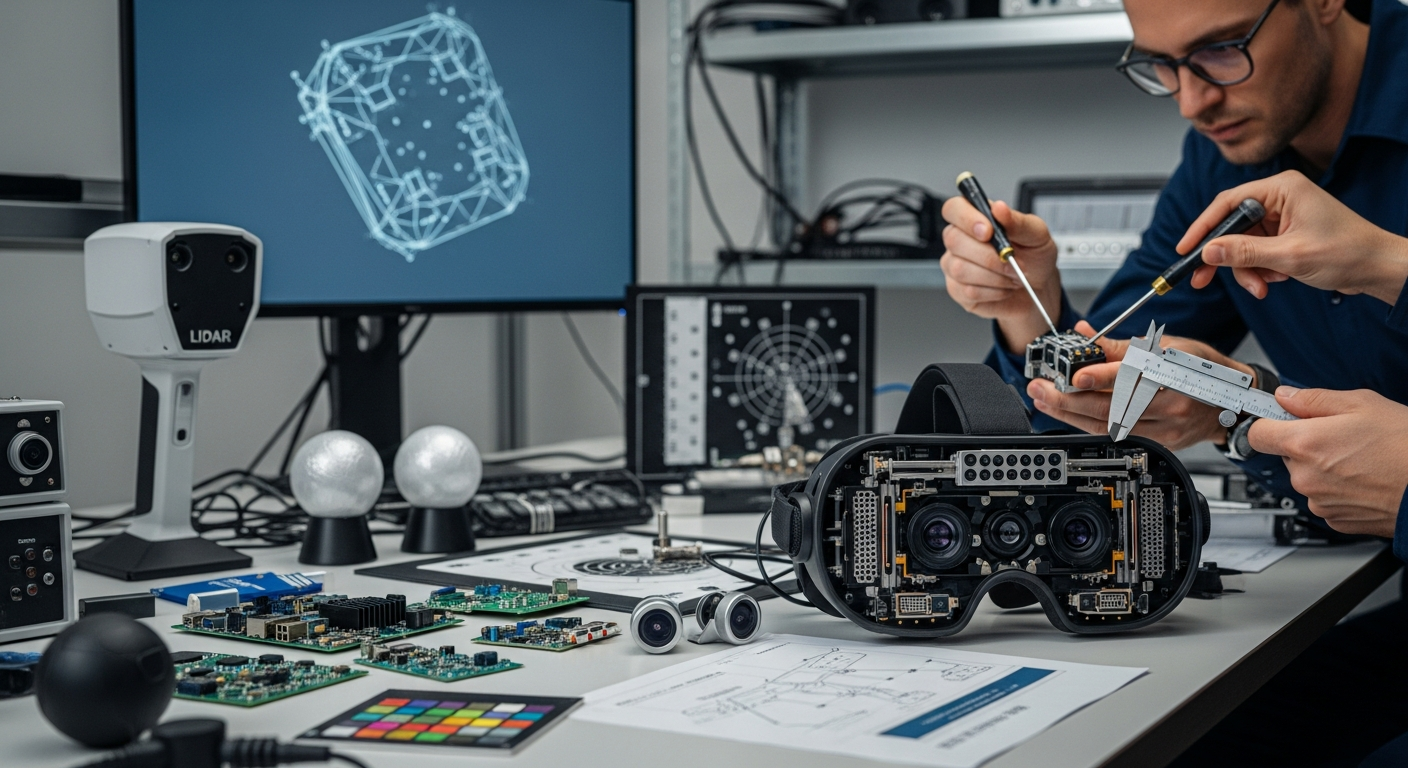
Mixed reality is moving from isolated demos toward persistent spatial workflows. Lighter headsets, better room scanning, real-time 3D engines, cloud rendering, and AI-driven characters will make MR easier to deploy across teams.
The next wave will connect MR to digital twins, adaptive training systems, product configurators, and shared 3D workspaces. These changes build on the same direction described in shared metaverse workspaces and in the broader shift toward immersive experiences that create presence and engagement.
Conclusion
Mixed reality solutions are most powerful when they solve a real spatial problem: training someone safely, showing a product clearly, guiding a complex task, or helping a team understand a shared 3D environment. The technology matters, but the experience design matters more.
Mimic XR brings together 3D modeling, scanning, motion capture, virtual worlds, smart avatars, and real-time XR development to create mixed reality experiences that feel useful, cinematic, and human. Talk to Mimic XR about building a mixed reality solution for your training, product, event, or enterprise workflow.
FAQs
What are mixed reality solutions?
They are applications that blend real environments with interactive digital content such as 3D models, instructions, digital humans, and spatial data.
How is mixed reality different from augmented reality?
AR usually adds digital overlays to the real world. MR goes further by anchoring digital objects in space and allowing deeper interaction with real environments.
Which industries use mixed reality most often?
Manufacturing, healthcare, education, retail, entertainment, design, customer service, and corporate training all use MR when spatial context improves understanding.
Do mixed reality projects require headsets?
Not always. Some experiences can start on mobile or tablet devices, while deeper spatial interaction may require MR headsets or AR glasses.
What makes MR useful for enterprise training?
MR connects instructions to the real environment, allowing employees to practice tasks with visual guidance, feedback, and safer repetition.
What assets are needed for a mixed reality experience?
Most projects need optimized 3D models, environment data, workflow steps, interaction design, performance targets, and clear content governance.
Can mixed reality include AI avatars?
Yes. Smart avatars and digital humans can guide onboarding, training, support, and simulations when their role and response boundaries are designed responsibly.
How do companies measure mixed reality ROI?
Useful KPIs include training completion, error reduction, task speed, engagement, conversion lift, support reduction, travel savings, and decision quality.